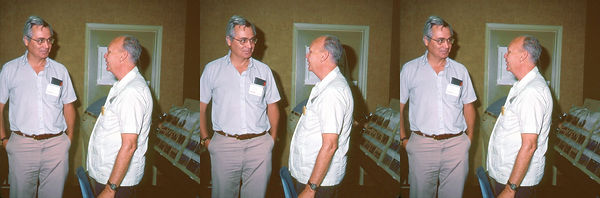
T.K. "Tex" Treadwell
June 6, 1920 - April 1, 2003
The list of things Tex did for the National Stereoscopic Association just gets longer the more you look, but that's only a small part of his life.
A Tex Memorial
T.K. Treadwell 1920-2003
by John Dennis
There are those whose biographies can too easily persuade most of the rest of us that somewhere along the line, we missed not just the boat but the train, the plane, the bus and who knows how many other opportunities for a far more interesting and exciting life. When Thurman Kelso
Treadwell died at age 82 on April 1, 2003, the world unquestionably lost one of those people, with that particular date adding a final ironic hint (as if needed) that his had been the sort of life a fiction writer would have found in need of serious editing to fit it all into a plausible narrative.
Early on in my affiliation with the NSA, I realized the organization was made up of individuals from an astonishing variety of backgrounds in the sciences, medicine, the military, academia and the arts. Some groups of collectors and enthusiasts evidently exist to alleviate the boredom of otherwise desperate people, but conversations at NSA conventions can effortlessly drift into intriguing subjects far from stereography that can be just as enlightening as the 3-D chatter. T.K. Treadwell was an extraordinary example of the rich variety of knowledge and experience to be found within the NSA.
I know that without our shared interest in stereo I would never have met anyone remotely like him—or even have imagined that anyone of the sort existed. Just one hint of the range of his expertise and experience can be found in the fact that "Tex" Treadwell, as he was known to anyone who had known him for more than two minutes, actually received awards from two NSAs— the National Stereoscopic Association and the National Security Agency. That this is just one minor detail buried in the story of a very busy life attests to its global complexity that can barely be touched upon here.
In 1993, with the private publication of the first installment of his multi-volume "Unauthorized Autobiography" Tex included these instructions in the cover letter: "I send it to you so that when it comes time for you to write my obit for Stereo World all you'll have to do is put them in a large iron kettle, boil them down for a week or so, and take out the residual short paragraph of worthwhile data."
It took a little longer than a week—the challenge being to boil hundreds of pages of stories based on his faithfully kept diaries down to something more than a paragraph but less than a book. It hardly helps that accounts of his high school and college days and of his many years in the Navy can make him seem like some unlikely fusion of Tom Swift, Henry Miller and James Bond.
Growing up smart and resourceful in the small Oklahoma town of Ada allowed him to mature early and perfect an ability to quickly put nearly anyone he met at ease. He described it as simply "a gift of gab", but it would eventually open the world to him.
Tex received his first camera at the age of 12 in 1932 and remained an active photographer for most of his life. By high school he had progressed to the point of processing his own film & shooting everything from scenics to nudes. His work would eventually be published in national magazines and receive several PSA awards, as well as lavishly illustrate his autobiography.
His early jobs included work in local cafes and newspaper delivery on his bike around Ada, which brought him into contact with some of the women who later posed for him. Riskier was his stint at capturing rattlesnakes for a lab that extracted venom. Caves in the area were easy sources for those willing to crawl in, but he decided to look for other employment after a second bite sent him to the hospital.
Following his passion for geology, he was collecting fossils along a roadside in 1933 when a man stopped his car and asked if Tex had any matches. A conversation about fossils ensued while the woman riding with the man offered Tex a hamburger from a bag. As they were about to part company, the man informed Tex that he had just had lunch with Pretty Boy Floyd and Wilma. Proof was offered the skeptical teenager when a sack of cash was lifted from among several guns on the floor of the car and a twenty handed him as a souvenir. After a quick agreement that Tex hadn't seen anybody, the couple roared off, about a year before Floyd was to be gunned down by the FBI in Ohio.
Pretty Boy Floyd wasn't the only "celebrity" Tex was to meet during geological field work. While at East Central State Teachers College, one of the visiting geologists he guided around the Ada area was Bill Darrah, who he would meet again years later after both had become interested in collecting stereoviews!
Tex graduated from Horace Mann High School in Ada, an institution that was virtually a part of East Central State Teachers College with an unusually qualified faculty. His small class in this
intensive educational environment developed into an elite group of bohemians whose outlook on sex, drinking, and life in general would have been more at home in the California of the 1960s than in the Oklahoma of the 1930s. After graduation, much of the same group made the easy transition to East Central State Teachers College.
Hoping to get into the Army Air Corps, Tex took Civilian Pilot training courses in 1941. During a final examination flight, the instructor ordered him to fly upside down, but the over eager student had forgotten to fasten his seat belt and fell straight out, parachuting down to a painful and embarrassing landing. After landing to pick up Tex, the instructor informed him, "I ought to wash you out for basic stupidity, but the war's just started and they're going to need even marginal cases like you." The date of that short 1941 flight was December seventh.
As if once weren't enough, Tex again fell from a moving aircraft some years later when doing survey photography. He hadn't yet fastened his safety line when the pilot of the helicopter tilted it toward the open door, dumping Tex out. Fortunately, he landed in dense forest canopy foliage about 15 feet below and was winched back into the chopper before slipping through the canopy.
In all, he survived four helicopter crashes as a passenger but went on to earn his wings in both fixed-wing aircraft and helicopters. His actual service in World War II was in the Navy, which led him from geology into oceanography and marine cartography. Although awarded medals for his marine acoustics research and three combat cruises as an officer aboard submarines in the western Pacific (receiving a Purple Heart), he jumped at the opportunity to join the Navy Hydrographic Office in 1945. Field survey work with this team would take him to Mexico, Labrador, Greenland, the Caribbean islands, Latin America and the arctic as well as to graduate study at the Scripts Institution of Oceanography. He had by this time married his college sweetheart Nell McNeely and started a family.
In the early 1950s he was contacted by Naval Intelligence and the CIA to collect information, first on scientific matters, later on political and military topics, in the various countries his surveying and oceanography assignments sent him. As Tex explained:
"From their point of view I was perfect, having both an entree and a plausible cover story. I had to be in foreign countries to do my work, and it was taken for granted that I'd be in touch with my peers in a variety of situations. My assignments expanded from adventitious windfalls of information into seeking out pieces of desired data, or carrying out specific tasks. Over the years these dealings became every bit as time-consuming as my nominal work but I didn't really mind; they indeed provided a welcome change from my usual administrative drudgery."
Just how much of a change that would be became evident in 1959 when, after asking to be assigned as Naval Attaché in Venezuela, he was instead sent to Haiti as Chief of the U.S. Navy Mission there. His cover was a training mission for the Haitian Coast Guard, but his real assignment was to make contact with the small Cuban diplomatic office in Haiti. The hope was that through informal, secret contacts, an opening for more U.S. communication with, and influence over, the new Castro government might be initiated.
Tex's main Cuban contact was Senora Martinez (a cousin of Fidel!), with whom international relations soon became very close, even if the proposed U.S. trade deals in exchange for Cuba abandoning Soviet support never got much attention outside Port-au-Prince. Tex concluded, "Castro felt (and I think astutely) that regardless of what we promised, America wouldn't support a socialist or communist-type government for very long; we'd play along and then jerk the rug out from under him at the first opportunity."
As Tex makes clear at several points, his wife Nell was completely aware of his extra-marital activities over the years, and neither had any doubts about their enduring feelings for each other. Whatever the nature of their commitment, their marriage lasted through absence and illness until Nell's death in 1992.
Thanks to his oceanographic contacts with several Soviet scientists through UNESCO and other international groups, Tex was picked by Naval Intelligence to participate in the first exchange of marine scientists between Russia and the U.S. in 1964. The fact that he was being sent to gather intelligence as much as share marine science was hardly a secret, as part of the agreement was that a Soviet naval officer would likewise be on the team coming to the U.S. The two naval officers, in fact, were allowed to start their respective visits a month ahead of the scientific teams—a measure of how much more easily the two intelligence and military communities could relate to each other than could the politicians.
The openness of the arrangement perfectly suited Tex's personality and pragmatic political outlook. In fact, he got along with most of the Russian scientists, security and military people better than with the others in his own visiting group. As a known spy (although he never worked directly for Naval intelligence or the CIA), Tex was assigned guides for the various parts of the USSR where he would visit marine science facilities. All were of course KGB agents, and all were attractive young women. Within hours of meeting them, Tex was able to learn what their KGB instructions regarding him were, and he related in turn what he had learned about them from his contact at the U.S. Embassy. The general idea was of course the classic effort to "compromise" the American officer to gain some influence over him.
With the knowledge and cautious approval of the embassy, Tex simply went ahead and enjoyed the attentions of the young women in the hope that more information would eventually be shared with a "compromised" agent than with one who remained intractably proper. He was equally open about this strategy itself, and later allowed the "secret" filming of one romantic encounter when he learned that the film would be used to train future KGB agents in the art of seduction.
He then actually talked his way into the first screening of the finished film at KGB headquarters. Not only was he given a "Visitor" badge to Building 127 (which most Soviet officials couldn't even enter), but just before the screening a high ranking KGB official handed him a KGB insignia watch as "a personal memento of our organization."
While touring marine research facilities around the USSR, Tex managed to do some actual spying by simply walking into the often adjacent naval bases and looking around. After an especially bold stroll through the nuclear submarine base at Murmansk, he returned to the lunch room through the same side door that led into the base and told the Russian security man what he had just done. After a brief conversation about arrest and expulsion or jail, Tex convinced the uneasy man that his best course was to further his career by warning his superiors of the potential for such a security breech rather than admitting that it had actually happened.
Using tactics that would leave James Bond either blushing or aghast, Tex made a number of visits to Russia setting up more reciprocal marine research programs— each time nudging science, military and government people from both sides a little closer to rationality. As one U.S. Embassy official put it, "You're either the slickest damn operator I ever ran across or the luckiest. But if this project does cool things down a little, you deserve a lot of the credit."
By 1968, Tex had wound down his international travels and found himself at about the highest position an oceanographer could reach—as the White House Senior Staff Scientist for Oceanography, Executive Office of the President.
As dull as a stateside desk job may have been, it didn't inhibit his independent personality or opinions. When he accepted a speaking offer from the State University of New York's Stony Brook Long Island campus, the very radical, anti-war student body was skeptical of nearly anything a Navy officer might have to say. "It was at the height of the Vietnam protests; the students were on strike and milling around on campus, chanting and raising harmless hell. I could've gone in civilian clothes and avoided problems, but decided to turn out in full uniform and rattle the cage a little, just for fun."
He was surprised to find a standing room only crowd that was, "attentive, inquisitive, and considerate. When I finished they asked a bunch of intelligent questions and applauded long and loud. One scruffy came to the podium, shook hands, and presented me with a small baggie of home-made joints as his token of appreciation." Once outside the hall, Tex sat down, lit a joint, and started a discussion group with some students in which he made clear his disgust with the Vietnam War. In 1969, Tex joined the academic world full time, becoming Professor and Head of the Department of Oceanography at Texas A&M University. In 1987 he became Dean of the College of Geosciences, retiring as Professor Emeritus in 1989.
The history and collection of stereoviews had been his growing interest for some time, and in 1974 Tex helped found the National Stereoscopic Association, writing the cover article for the first issue of Stereo World. Besides writing several historical articles and book reviews, Tex profiled early stereoview collectors, some of whom had been active as early as the 1940's.
An expertise in organization brought him into the day to day running of the NS A when he assumed the presidency in 1980. He served for eight years—the longest presidency in NSA history. He also served on the board of directors and was appointed Board Member Emeritus in 1998.
While Tex was preparing the first volume of his autobiography in 1993, the Ada Evening News ran a story about the project and included a list of people from his youth he wanted to hear from. After only two responses arrived initially, he received a letter in 1994 from the former Joleeta Little, one of those on the list.
In 1997 Tex and Joleeta were married. They shared the work of preparing material for the Institute for Photographic Research, through which several stereo related monographs were published. These were available via the NSA Book Service, which Tex operated out of his home for several years along with the Stereo World Back issue service. At NSA conventions, Tex and Joleeta were truly a welcome sight in any hotel lobby, with her effusive warmth adding a
dose of tonic to every gathering. The list of things Tex did for the NSA just gets longer the more you think about it. In 1981, when the organization had spent more than it should have in publishing Peter Palmquist's Lawrence & Houseworth book, he provided financial support to keep the group functioning. In 1997 he produced (with help from Joleeta) a Stereo World index covering volumes 1 through 23. He spearheaded the effort to republish Darrah's classic The World of Stereographs, (Land Yacht Press, 1997) by working with Darrah's family and the publisher. He was an early supporter of including present day stereography in Stereo World and at conventions through the Stereo Theater. He did surveys of the membership to determine as closely as possible the percentages of collectors, shooters, and those interested in both. Through the years, he did his best to keep us honest, on our toes, and aware of looming problems. His suggestions were as well informed as his opinions were blunt, but the man who could sound like a curmudgeon one minute could be offering research help to a total stranger the next.
His support for Stereo World, myself, and Art Director Mark Willke over the years combined encouragement with a real appreciation of our efforts and a steadfast defense of editorial and artistic independence. His presence, in person at conventions or via letter or email, was always reassuring. Without him, an awareness that we are all on our own now grows more concrete every day.
-John Dennis
STEREO WORLD Volume 29, Number 4

1983 International Stereoscopic Union, Wash DC
Tex Treadwell and William Darrah by John Dennis